

Successful Websites – The Book Project
Successful Websites – The Book Project
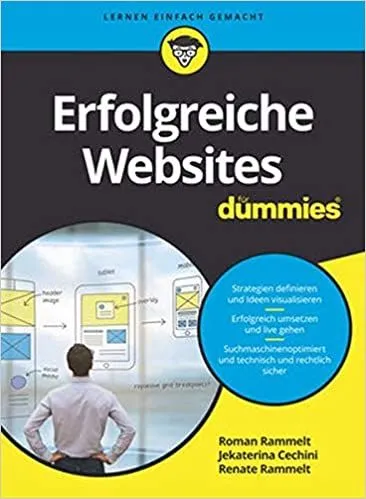
e-pixler has been involved in website creation for years and, as a full-service digital agency, of course also with everything that goes with it. We had the opportunity to compile exactly that in a book. “Successful Websites for Dummies” was published at the beginning of the year by Wiley-VCH.
The “For Dummies® series” is aimed at people who are interested in a particular topic and want to expand their existing knowledge as simply and quickly as possible – and in an entertaining way.
Do it yourself or hire an agency
There are a lot of tasks to master on the way to a successful website. Some people set out on the journey alone or as a team, while others hire an agency. In both cases, it is an advantage to know the individual phases and tasks involved in website creation. That is why the book attempts to bridge the gap.
Anyone who does not want or cannot create their web presence themselves will, by reading the book, be able to communicate with their service provider on equal footing. Anyone who gets hands-on can pick up a lot of specialist knowledge as well as tips and tricks. And anyone who simply wants to refresh their knowledge can use the so-called cheat sheets. Here there is a very short summary, from planning a website and gathering requirements to the most important success factors.
Finding the desired topic with purpose
The book is divided into five parts. At the beginning of each part or chapter, interested readers will find a list of the topics covered there. In addition, there is a detailed table of contents right at the front. At the end of the book, an index points the way to individual topics. – This way, everyone can orient themselves perfectly and browse purposefully to where they will find their information, tips, and background.
Let’s take a quick look inside the book to give a first impression:
Strategy, ideas and planning
The question of all questions comes right at the start and is: Why should a website be created?
- Selling products and services
- Providing information
- Maintaining the image of your person, your company, or your products
- Many visitors for indirect revenue sources
- …
Successful websites are characterized by having a clear goal they are meant to fulfill. And this goal is reflected in the structure, in the content, in the tone of voice – in short, in everything. So it is important to formulate goals correctly, and the SMART method can be very helpful here:
S – Specific:The goal should be formulated as concretely as possible so that it is ensured that everyone understands the same thing by it.
M – Measurable:Goal achievement should be measurable. “Many visitors” is not enough, because everyone might understand something different by it.
A – Accepted:The goal should be accepted by everyone involved in the team and should be motivating.
R – Realistic:Of course, there should also be a chance of being able to achieve the goal with reasonable effort.
T – Time-bound:And finally, it should be clear by when the goal or defined interim goals are to be achieved.
In this part, among other things, it is also about how target groups are identified and given a voice, or how the website project should be planned according to the budget, time, and content requirements.
Concept and design
Before starting to set up or program a website, the ideas should be visualized and perhaps different concepts tried out. In this part, the reader learns what visualization options there are, what the difference between wireframes, mockups, and prototypes is, and which testing methods can be used.
Implementation
- And now we’re getting into the thick of it. Because this part deals with the actual creation of the website. The following questions are in focus here:
- What generally happens when a website is accessed?
- Which technologies can be chosen for implementation – what are the respective advantages and disadvantages?
- How can collaboration with an agency or a team be organized?
- How does domain registration and hosting work?
- How is good content for the website created?
- How are users brought to the website with the help of search engine optimization, and which measures can be used to measure the success of the website
- What needs to be considered regarding accessibility, security, data protection, and optimization for different end devices?
The questions make it clear: a great deal of expertise has to be brought together. And that is surely also what makes the book project “Erfolgreiche Websites für dummies” special. Here, knowledge and experience from a wide range of fields come together from the respective experts. One of the book’s strengths is that it provides the necessary knowledge for everyone involved in creating a website in a well-structured and clear way. In addition, there are many extra offerings, such as an introduction to practice-oriented methods and techniques.
Of course, reading does not end when the website is completed.
The launch and what comes next
The go-live is of course the absolute highlight, but not at the same time the end point of the work done. The fourth part is about how error-free operation and functionality can be tested. It covers online marketing measures as well as further tasks involved in the maintenance, servicing, and further development of the website after the go-live.
Once the circle of expertise for creating a successful website has come full circle, the transfer of knowledge ends with a top-ten section that also addresses, among other things, pitfalls that can be avoided in the future.
In the book, the authors take center stage. We have reserved this section for the end.
About the authors
Roman Rammelthas been working in the field of the internet and digitalization for more than 20 years and has since been responsible for over 500 web projects.
He started his career as a freelance web developer. After completing his degree in computer science, he founded the internet agency “e-pixler” in 2008, where he has since been working as managing director. The agency currently has around 45 employees and offers the complete value chain for web projects with strategy, design, editorial work, programming, usability, apps, search engine optimization, and hosting. From the very beginning, user centricity was an important aspect of his work. Creating great websites with real added value for users that are easy for everyone to use is his stated goal.
Jekaterina Cechinihas been working in the internet industry for more than 14 years. After studying psychology, she specialized in human-technology interaction and usability and initially worked in an agency responsible for testing websites and product interfaces for user-friendliness. There she observed firsthand what users value in good websites and what problems they have with them.
From 2009 onward, she worked in various positions at ImmobilienScout24. As UX team lead, she built up the usability lab and established UX testing as an integral part of the development of the website and apps. In business development, she led large web projects, among other things, and built up strategic expertise. As head of product management in the developer segment, she further developed the web presence for her target groups with the team using agile methods.
She currently works for Germany’s largest public transportation company, Berliner Verkehrsbetriebe, and is responsible for the digital sales channels website and apps.
Renate Rammeltafter studying journalism, worked for various weekly newspapers, mainly in the areas of lifestyle/everyday life and science. When writing her texts, alongside uncovering exciting stories, her primary aim was to present complicated specialist topics in a way that laypeople could understand and enjoy.
Over the past 15 years, she has worked as an online editor at communications and internet agencies. For the customer service of major mobile network providers, she developed text modules based on the four-color model of reader temperaments. Reliable in process and tailored to target groups, they made individual customer support easier. At the full-service internet agency »e-pixler«, she was responsible for content creation during website launches or relaunches and, for smaller projects, also took on the entire project management. In addition, she regularly writes for newsletters in various industries and social media channels.
For everyone who wants to learn even more about creating successful websites.
Erfolgreiche Websites für Dummies (Deutsch) Paperback
Erfolgreiche Websites für Dummies
ISBN: 978-3-527-81580-7
Aktuelles zu „General“
Alle Beiträge anzeigen


Sie wollen ein Projekt mit uns realisieren?
Schreiben Sie uns gern oder rufen Sie uns an unter
