

TYPO3
It is one of the most widely used content management systems (CMS) in Germany. The open source project impresses with its flexibility, an active global community, and a wide range of expansion options. You can find out here why we love the CMS and whether it is the right one for you.

How a Typo Error Led to a Successful CMS
The history of the content management system dates back to the late 1990s. At that time, Danish developer Kasper Skårhøj lost an important part of his work due to a simple typo. This typo (in English: typo) was to become the namesake for the young system. And so, with the release of the first stable and largely complete version3in 1998, a CMS was born that still bears this name today: TYPO3
Why TYPO3?
In short, there is almost nothing that cannot be done with TYPO3. With this CMS, highly performant and feature-rich websites can be implemented in a wide variety of use cases. Even if very specialized solutions are to be used, they can often be integrated into a system as components.
The most important advantages at a glance

Scalability
With this content management system, even large-scale offerings can be implemented well; multilingual systems or multi-domain systems are no problem here. The system can grow with your company without requiring a system change. It is also easily possible to start with a simple website and later add additional languages, for example. It is also easy to map additional websites in the same system or set up internal areas. This allows the CMS to play to its strengths especially for international presences.

Security
TYPO3 stands for one of the most secure content management systems. Through the continuous further development of the code, the system’s foundation is also continually kept up to date with current technical requirements. The community is organized here with its own security team, regularly informs about possible security vulnerabilities, and recommends corresponding updates.

Permission management
The CMS has a very finely granulated permission system. This makes it possible to map permissions according to page sections as well as content in parallel. Which pages can an editor edit, and which content can be used? It is possible to enable or disable every single option in the backend via permissions for editors. This means the backend contains only exactly the tools and options that the editor actually needs.

Extensions
A wide range of extensions can be used to expand the system with many additional functions. Thousands of mostly free extensions are available for this purpose. For special business processes, custom extensions can also be developed and tailored individually to your specific requirements.


Distribution
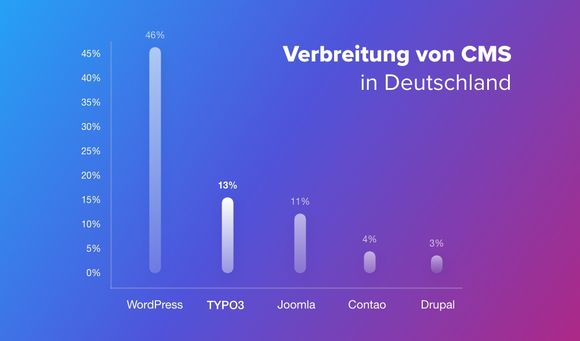
TYPO3 is a very popular CMS, especially in German-speaking countries. However, when comparing the prevalence of content management systems, one should not consider only pure frequency. Rather, factors such as the technical scope of the developed web solutions play an important role. While WordPress is the most widely used CMS in Germany as well as internationally, TYPO3 is more often used for complex custom developments.
Costs and licensing
The open source CMS is licensed under the GNU General Public License, so there are no one-time, recurring, or hidden licensing costs for the software. The available funds can therefore be directed where they are important for your project, i.e. into employee training, further development, or maintenance of the system.
In contrast to paid content management systems, under TYPO3 it is therefore irrelevant from a licensing perspective how many:
- User accounts you need
- freely available extensions you use
- projects you want to implement
- server instances you want to operate
- domains you use
Multilingualism
Do you work with an editorial team spread across different regions, or would you like to make your offering accessible to an international audience?
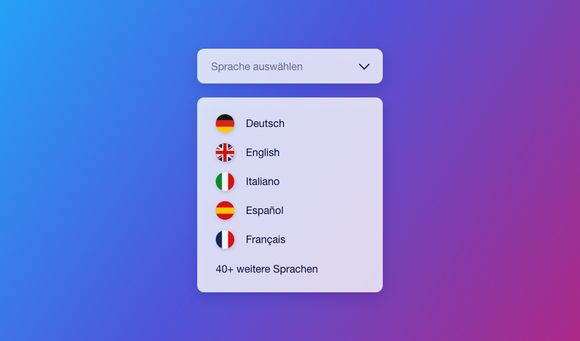
No problem, because TYPO3 offers multilingualism in two ways. Not only can web projects be implemented in multiple languages, but it is also possible to display the entire backend in more than 30 languages. This gives editorial teams the opportunity to set the backend interface to their own native language and work in it.
Active working groups and community
An active community has been involved in the further development of the CMS for many years and continues to grow steadily. The maintenance and further development of the system take place completely transparently; there are self-organized working groups that keep topics such as accessibility, security, trends, etc. at the forefront of project development and drive them forward. This also secures all the prerequisites for future development.
Industries with special requirements
What makes e-pixler special as a TYPO3 agency?
Quite simply: We are a team of certified developers, consultants and editors, and we live TYPO3!


TYPO3 for clinics


TYPO3 for transportation companies


TYPO3 for care facilities


TYPO3 for educational institutions
Our TYPO3 certifications


Is TYPO3 the right CMS for your company?
We can help you with the decision-making process. Feel free to contact us!