

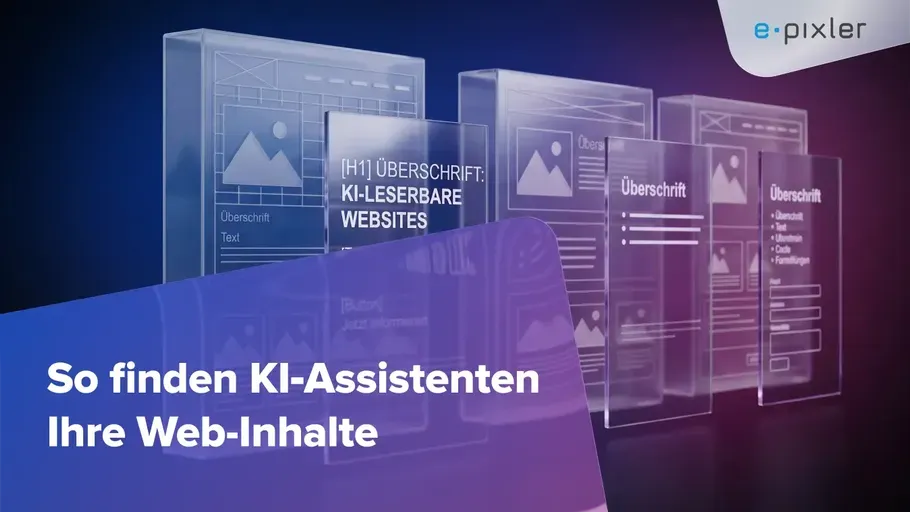
AI-readable websites: Why companies should prepare their content for LLMs now
AI systems are changing how people search for, compare, and evaluate information. Alongside traditional search engines, LLMs, AI assistants, and increasingly AI agents are becoming new interfaces between companies and potential customers.
For websites, this means content should no longer be prepared well only for people and search engines. It should also be structured so that AI systems can read, understand, and classify it as easily as possible.
This is exactly where llms.txt and Markdown versions of web pages come in.
Why AI-readable content is becoming relevant for companies
Many company websites contain good content: service descriptions, references, industry knowledge, contact information, advisory articles, or technical details. For human visitors, this content is often visually appealingly designed. For AI systems, however, this presentation can create unnecessary hurdles.
Navigation, layout, animations, JavaScript, recurring page elements, and complex components make it harder to quickly grasp the actual content. The information is there, but not always in the form that an LLM can process optimally.
This can mean that services are not clearly recognized, specializations are overlooked, or important company information can be difficult to extract from the page.
An AI-readable website creates an additional layer for this: the normal website remains optimized for people, while central content is additionally provided in a reduced, structured form.
What companies gain from this
The main advantage lies in the better accessibility of their own content. When services, competencies, and contact information are clearly structured and machine-readable, AI systems can more easily capture them and classify them correctly.
This does not guarantee appearing in AI answers, but it creates better technical conditions for future digital visibility.
For companies, this is particularly interesting for three reasons:
- the company website is better prepared for use by LLMs and AI agents.
- the risk decreases that relevant information gets lost in complex layouts or scattered page structures.
- this extension can often be implemented pragmatically without having to visually rebuild the existing website.
The HTML page remains as usual. The Markdown version complements it for machine processing.
What is an llms.txt?
A llms.txt is a text file in the root directory of a website. It can give LLMs and AI agents guidance on which content is particularly relevant and where to find it.
You can think of it as a compact guide for AI systems. Instead of having to search and interpret a website completely, a system receives a curated overview of important pages, content, and entry points.
This is especially useful for service pages, references, about-us content, contact information, advisory articles, or other pages that explain what a company stands for and what services it offers.
Why Markdown?
Markdown is a reduced, easy-to-read text format. Headings, paragraphs, lists, and links are retained, while visual layout elements, navigation, design components, and JavaScript fade into the background.
For LLMs, this is helpful because the actual content becomes more clearly visible. Instead of first filtering the relevant text out of a complex HTML page, an AI system can work directly with a structured content version.
Once the technical foundation has been created, all relevant pages can generally also be provided as Markdown versions.
Our practical example at e-pixler
We have implemented this approach on our own website.
In addition to the normal website, we provide an llms.txt. Our pages are also available with a .md extension, for example:
https://www.e-pixler.com/leistungen.md
This not only shows theoretically how AI-readable content can work, but also uses the company website as a practical example.
The crucial point: Our editors do not have to take on any additional maintenance process for this. The content continues to be maintained in the CMS as usual.
How we implemented it technically
Our website is based on Payload CMS. When content is saved, a hook triggers that automatically converts the CMS content into Markdown. This creates a Markdown version of the respective page in addition to the normal HTML output.
The process is simplified:
Save content in Payload CMS → hook converts content to Markdown → Markdown version is provided → website can deliver HTML or Markdown
In addition to the .md-URLs, we also support content negotiation via HTTP headers. This means a client can specify which format it prefers.
If a request comes with the following header:
Accept: text/markdown
the backend can deliver the Markdown version directly instead of the HTML page. This changes nothing for normal website visitors. They will still see the designed website. Systems that request Markdown, on the other hand, receive a reduced, machine-readable version of the content.
This keeps the solution automated, maintainable, and closely aligned with the existing CMS process.
Check the website now
Many companies still do not know whether their website is already prepared for LLMs. That is why we provide a simple URL check at the end of this article.
Enter your website URL. Our tool checks whether a llms.txt file exists and whether the homepage returns a Markdown version when requested with Accept: text/markdown .
Enter your website URL. Our tool checks whether an llms.txt file exists and whether the homepage returns a Markdown version when requested with Accept: text/markdown.
If your website does not yet support llms.txt or Markdown output, that is no problem. It only shows that there is technical optimization potential.
Contact us if you would like to make your website more accessible for LLMs, AI systems, and future AI agents.
Aktuelles zu „General“
Alle Beiträge anzeigen


Sie wollen ein Projekt mit uns realisieren?
Schreiben Sie uns gern oder rufen Sie uns an unter
